

How Basements Become Leaky - And Why Drought Makes It Worse
As an Idaho local, if you're starting to notice leaks in your basement, you might be scratching your head.
It's been an especially dry year. In fact, 2026 has been among Idaho's most dry years since 1895.
Now, suddenly — even after mild rain — your basement is leaking worse than it ever has before.
The truth is that dry weather contributes to leaky basements too. To understand why, let's break down why basements leak in the first place.
The Battle You Can't See Until It's Too Late: Water vs Your Foundation Walls
It all starts with a simple rule of hydrodynamics: water flows downhill.
After the construction of your home, loose soil (called backfill) is used to fill the hole around the home's foundation. This soil will settle, especially in the first few years, which draws water downhill towards your foundation.
Over time, the earth near your foundation retains more and more water, and creates hydrostatic pressure.
This means your basement is a hole in the ground lined with concrete walls — a porous material with cracks, holes and joints — and it has water pushing against the walls, trying to flow downhill.
Eventually, the water finds the voids, and your basement leaks.
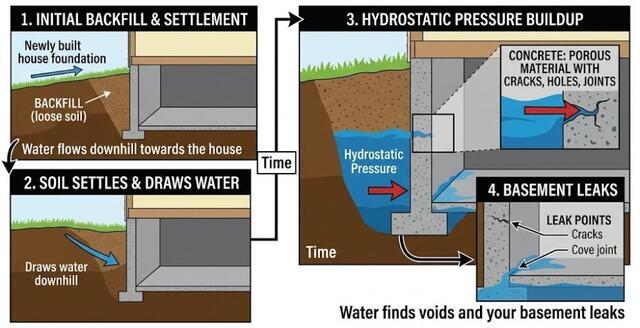
How Drought Affects Your Backfill
You might think drought gives your basement a much-needed break from water. That might be true, to an extent.
However, when it finally rains again, it's very common for even more water to break through and leak.
Why? In periods of drought, the soil shrinks away from the foundation, leaving voids for the next rain to easily flow down into your basement.
Basically, drought helps channel water directly to your foundation walls, pushing higher volumes of water against your walls and increasing the hydrostatic pressure against them — therefore, causing more leaks.
To Solve the Problem, You Need To Redirect the Water
A lot of people think they can dampproof their foundation walls with chemicals that will make their concrete 'non-porous' for a time. However, these solutions are temporary since they don't address the root cause: hydrostatic pressure. The water will always be pushing in towards the wall, trying to break in.
Rather than stop the water, you need to help redirect the water, and then send it away from the foundation. An interior drainage system and sump pump will capture the water and remove it from your basement, keeping it dry for years to come.
Want to see if our state-of-the-art interior waterproofing solutions are right for you? We provide free inspections and estimates. Thanks for reading!
